The so-called magic of the number 37
This post is satire. It may also not make too much sense.
Today I’ve seen this picture on my LinkedIn wall:
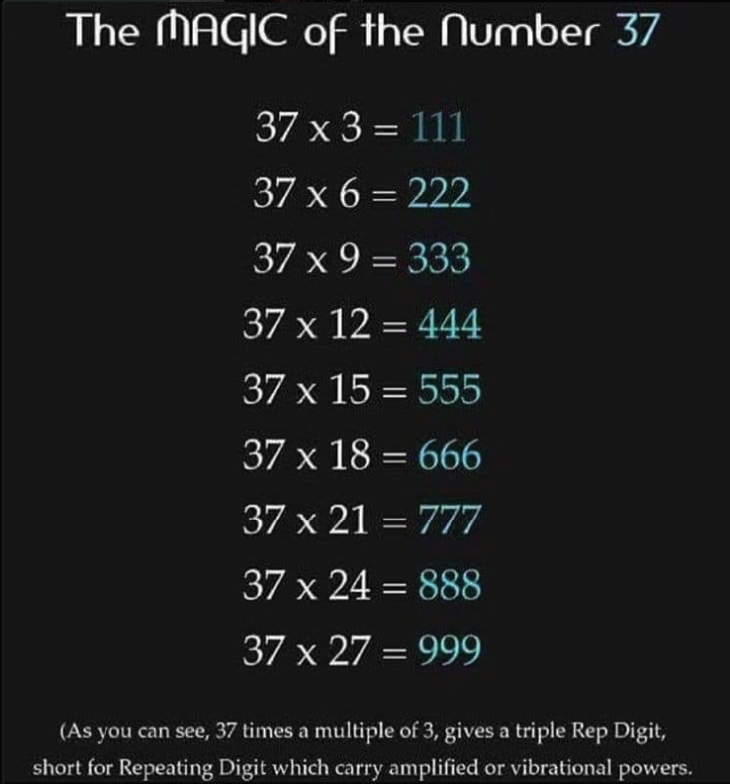
And it triggered me badly. There are people in my network who are highly sensitive to the divine nature of numbers. As a math enthusiast, I just don’t get it.
So, for all the people believing in numerology, let’s find the numbers that carry highly amplified and/or uber-vibrational powers, more than you can possibly imagine.
Keep in mind that $37$ is super-weak compared to $15873$:
The magic of the number 15873

15873 x 7   = 111111
15873 x 14  = 222222
15873 x 21  = 333333
15873 x 28  = 444444
15873 x 35  = 555555
15873 x 42  = 666666
15873 x 49  = 777777
15873 x 56  = 888888
15873 x 63  = 999999

(As you can see, 15873 times a multiple of 7 gives a sextuple repdigit,
short for 'Repeating Digit', which carries amplified or vibrational powers.)
But let me tell you, even $15873$ is super-weak compared to other numbers that carry uber-highly-amplified and/or uber-highly-vibrational powers. So let’s write a small Python script that can list more vibrationally powerful numbers (whatever that is) than $37$ and $15873$.
from primefac import primefac
from collections import Counter
import sys

def compute_vibrational_num(vp):
    n, res, vp_ret = 1, 0, vp
    while vp != 0: n, vp = 1000 * n + 1, vp - 1
    n *= 111
    primef = Counter(list(primefac(n))).most_common(2)
    primef = primef[1 if primef[1][0] == 7 else 0]
    magic = primef[0] ** primef[1]
    res=n//magic
    return (magic, int(res), vp_ret)

def print_text(tpl):
    print(f"The magic of the number {tpl[1]}")
    for i in range(1,10):
        print(f"{tpl[1]} x {tpl[0]*i} = {tpl[1] * tpl[0] * i}")
    print(f"""
(As you can see, {tpl[1]} times a multiple of {tpl[0]}, gives a {(tpl[2]+1)*3}-tuple repdigit,
short for Repeating Digit, which carries amplified or vibrational power.)
            """)
Yes, I know, it looks bad, and you also have to install a pip package called primefac to do the hard work for us. Now, the vp parameter from our function gives us the vibrational power (whatever that is) of the number.
For example, if we call print_text(compute_vibrational_num(0)), we get the results from the picture (that’s boring):
The magic of the number 37
37 x 3 = 111
37 x 6 = 222
37 x 9 = 333
37 x 12 = 444
37 x 15 = 555
37 x 18 = 666
37 x 21 = 777
37 x 24 = 888
37 x 27 = 999

(As you can see, 37 times a multiple of 3, gives a 3-tuple repdigit,
short for Repeating Digit, which carries amplified or vibrational power.)
But if we increase the vibrational power of the number to, let’s say, vp=13, we will get something significantly more powerful:
The magic of the number 2267573696145124716553287981859410430839
2267573696145124716553287981859410430839 x 49 = 111111111111111111111111111111111111111111
2267573696145124716553287981859410430839 x 98 = 222222222222222222222222222222222222222222
2267573696145124716553287981859410430839 x 147 = 333333333333333333333333333333333333333333
2267573696145124716553287981859410430839 x 196 = 444444444444444444444444444444444444444444
2267573696145124716553287981859410430839 x 245 = 555555555555555555555555555555555555555555
2267573696145124716553287981859410430839 x 294 = 666666666666666666666666666666666666666666
2267573696145124716553287981859410430839 x 343 = 777777777777777777777777777777777777777777
2267573696145124716553287981859410430839 x 392 = 888888888888888888888888888888888888888888
2267573696145124716553287981859410430839 x 441 = 999999999999999999999999999999999999999999

(As you can see, 2267573696145124716553287981859410430839 times a multiple of 49, gives a 42-tuple repdigit,
short for Repeating Digit, which carries amplified or vibrational power.)
I wish you luck in finding the most vibrational number your hardware allows.
Repdigits are natural numbers composed of instances of the same digit. The coolest repdigits are the Mersenne primes.
They are prime numbers that, when represented in binary, are composed entirely of 1s.
All in all, let’s get back to our powerful vibrational numbers (whatever that means).
Numbers like $11…1$ can sometimes be prime, but if the number of 1 digits is a multiple of 3, we know for a fact that they aren’t. Here is a simple proof:
If we group the digits in sets of three, we get the following relationship:
$$ 111...111 = \underbrace{(1 + 10 + 100)}_{111} + ... + 10^{3i-3}*\underbrace{(1 + 10 + 100)}_{111} $$And then if we use $111$ as a common factor, we obtain:
$$ 111...111 = 111 * (1 + 10^3 + ... + 10^{3i-3}) $$But $111 = 3 \times 37$, so repdigits with a number of digits that is a multiple of 3 are always divisible by 3 and 37. As an interesting observation, they are from time to time divisible by 7 (but not always).
This is exactly how our code functions:
- It generates numbers like $111..111$;
- It gets their prime factors (we know for certain they are not prime);
- Then it separates the prime factors into a “bigger”, highly vibrational number, and keeps a multiple of 3 or 7 as the meme multiplier.
Source Code & Contributions
Spot an error or have an improvement? Open a PR directly for this article .